

What this article shows you
Angle Finder turns source material into campaign angles, hooks, and mechanisms you can evaluate. It combines research with StefanBrain’s creative intelligence instead of returning a list of links alone.Practical use cases
#1: Reddit customer voice
#2: Science-based mechanisms
#3: Translocate research
#4: Competitors and reviews
Watch the walkthrough
See four Angle Finder workflows, then follow one selected angle into copy and native-style images. Duration: 18:38.
Video chapters
How Angle Finder fits into Chat
Angle Finder is one way StefanBrain can complete a research job. Start by describing the outcome naturally. You can ask StefanBrain to use Angle Finder without selecting it from Tools. This flexible path lets StefanBrain use Angle Finder, deep research, or another useful combination. Review research, for example, may use deep research instead of forcing Angle Finder.What you will do
- Choose one research use case.
- Describe the result, relevant context, and evidence to use.
- Inspect the source context behind the results.
- Select one angle with a credible product bridge.
- Develop that angle into the next campaign asset.
Before you start
Prepare:- One product or offer.
- One market, audience, or niche.
- One research goal, such as cold-traffic ad angles or mechanisms.
- The next deliverable you want after the research.
@Your Product when you want StefanBrain to use
that Product’s saved context.
Give StefanBrain the complete job
A useful request starts with the outcome, then adds the context and evidence that materially change the job. Ask directly for the deliverable your team will use. Name a research strategy or source only when you need that exact path. For example, this request gives StefanBrain a clear business outcome without turning the prompt into a form:Use case #1: Find customer language on Reddit
Use Reddit when you need emotional language, objections, failed solutions, or beliefs expressed in the customer’s own words. In the hair-loss example, one Reddit quote describes a doctor dismissing hormone-related hair loss. That tension can support an authority-based angle about feeling abandoned by the medical system. The same research identifies fear around starting and stopping minoxidil, which can support a different angle around dependency.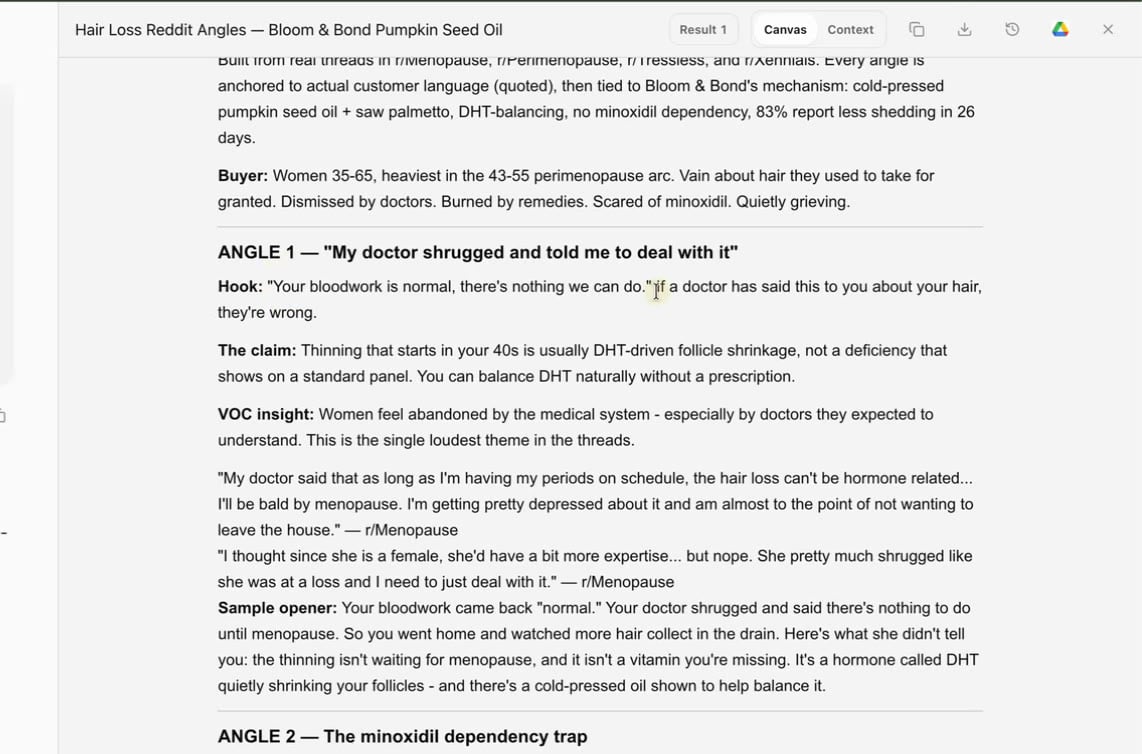
Source-linked Angle Finder results built from Reddit customer language.
What to inspect
- The exact customer quote and its context.
- Whether the emotion appears across several discussions or only once.
- The bridge from the quote to your product.
- Whether the angle can lead naturally to the campaign you want to create.
Useful next request
Use this follow-up to group repeated tensions and decide which five angles deserve the first creative review:Use case #2: Find science-based mechanisms
Use scientific sources when you need possible mechanisms, emerging explanations, or research-backed starting points. Research in the hair-loss category can surface mechanisms such as cellular senescence, described as “zombie cells,” and an anchor-protein mechanism connected to follicle stem cells.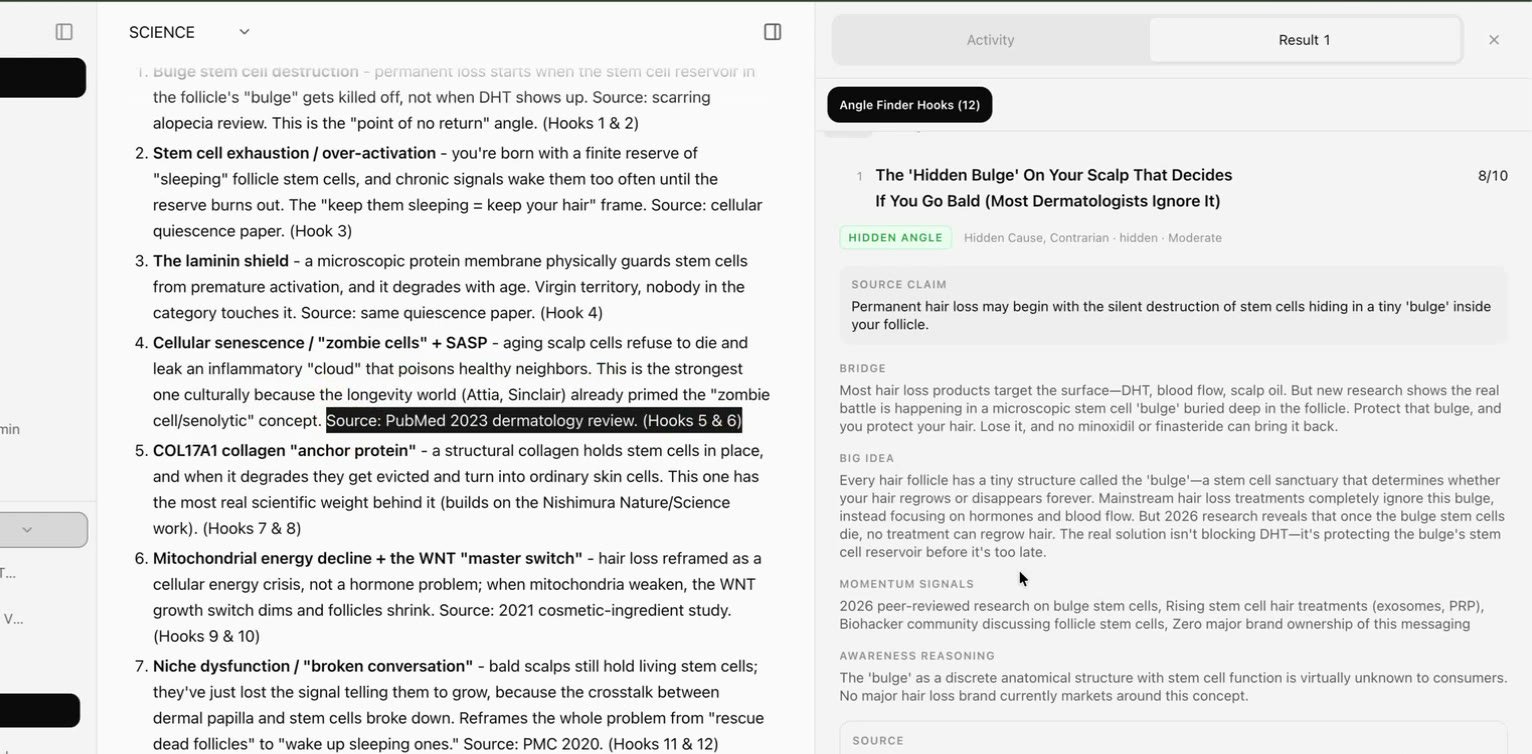
Science-based mechanism ideas beside the source details in Angle Finder results.
What to inspect
- Whether the source is a primary study, review, preprint, or summary.
- Whether the research studied the right audience, condition, and outcome.
- Which words come from the source and which are StefanBrain’s interpretation.
- Whether the product can credibly connect to the mechanism.
Useful next request
Use this follow-up to compare the mechanisms and choose which one warrants deeper product-fit and source review:Use case #3: Borrow ideas from other niches
Use Translocate when your category repeats the same hooks and you want less obvious starting points. It searches adjacent or distant domains, then explains the bridge back to your product. A cross-category result can link a 400-million-year-old plant-defense story to phytosterols in pumpkin seeds, creating a less familiar concept to evaluate for further development.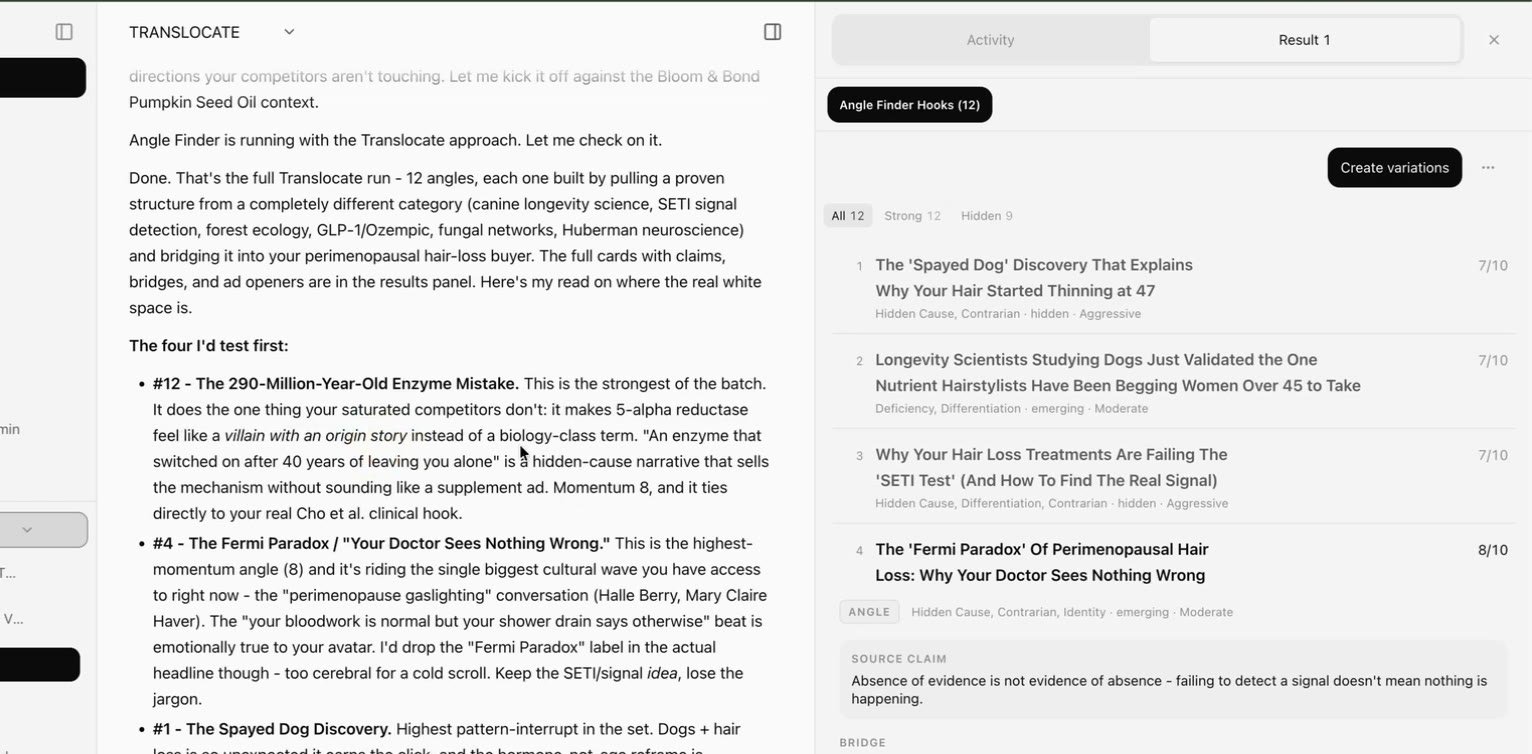
A Translocate result and its bridge from another domain back to the product.
What to inspect
- Whether the borrowed idea has a clear bridge to the product.
- Whether the angle still matters to the target customer.
- Whether the idea is useful, not merely unusual.
Useful next request
Use this follow-up to narrow the results to the three ideas with the clearest product bridge:Use case #4: Mine competitors and reviews
Use reviews, comments, and competitor discussions to find buying objections, feared trade-offs, positive sentiment, and phrases customers repeat. Research across hair-loss products and competitors can surface repeated fears about minoxidil dependency and shedding, plus frustration with doctors and slow results.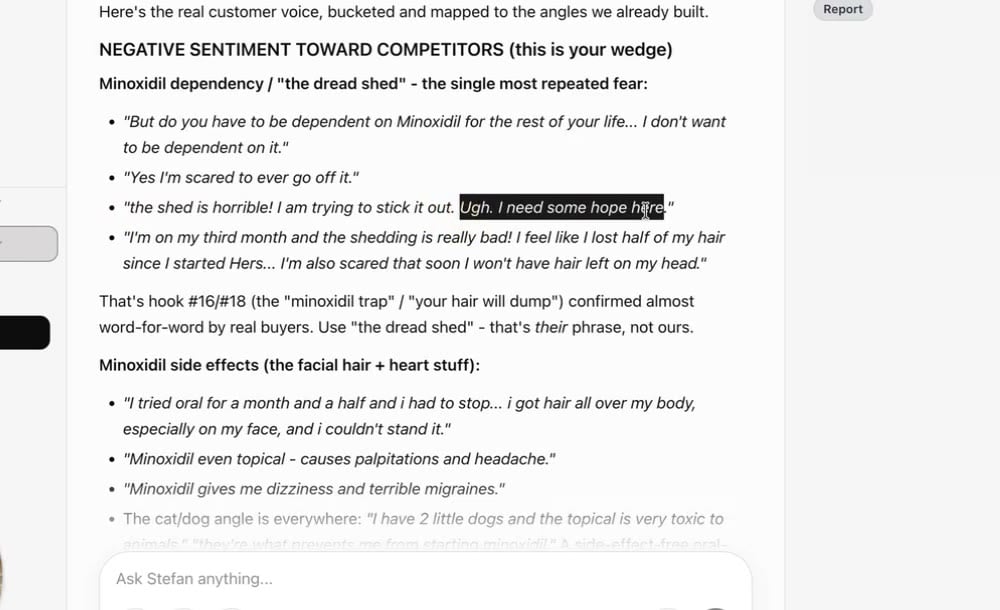
Competitor-review language organized into recurring objections and customer sentiment.
Turn one angle into campaign assets
Choose an angle before asking for finished creative. Continue in the same Chat so the evidence and selection reason stay connected.Name the exact angle
Choose one deliverable
Set useful constraints
Check the handoff
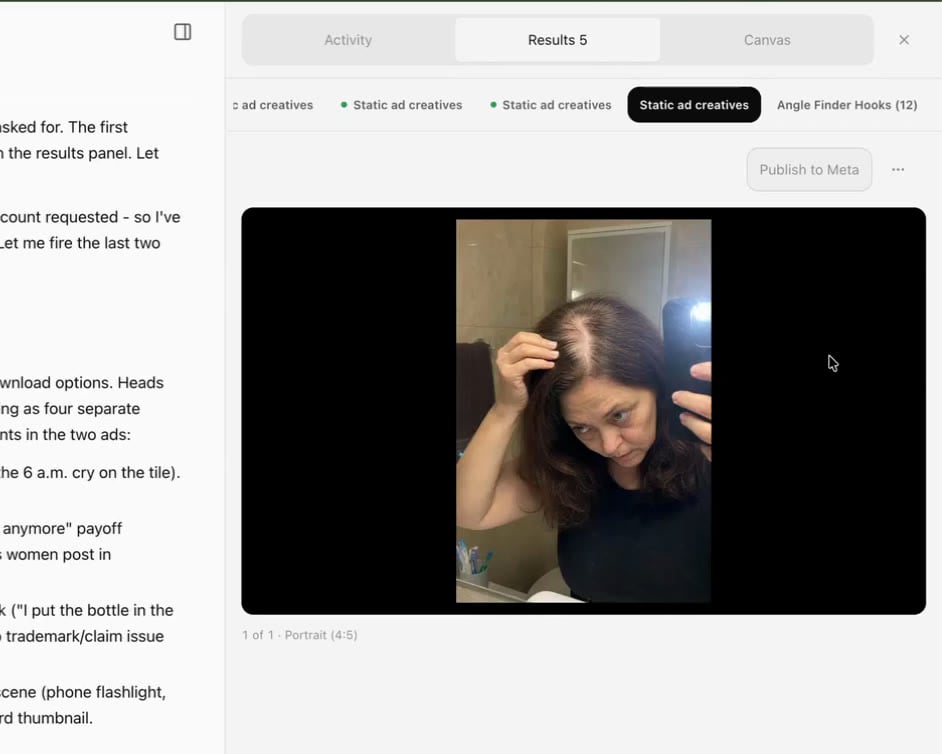
One selected Translocate angle developed into a native-style image concept.
Manually select Angle Finder for rigid control
Use this path only when you need one strategy, constrained source types, and Angle Finder’s source-driven result format.Select Angle Finder

Angle Finder selected in the current Chat composer.
Choose Direct or Translocate
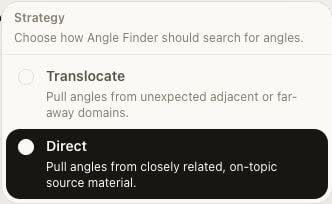
Direct searches related material; Translocate searches more distant domains.
Choose source types
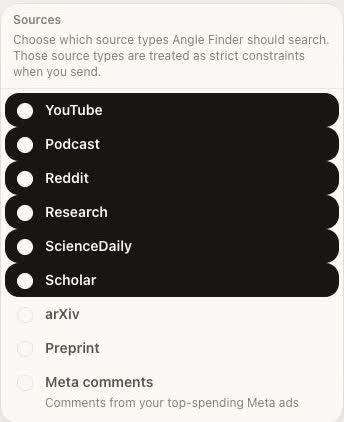
Choose the source types that fit the research question.
Send one focused request
Check the output
- Identify the audience tension behind the angle.
- Confirm which quote, observation, or source supports it.
- Check that the bridge to the product is clear.
- Separate what is sourced from what is inferred.
- Choose one concrete hypothesis or deliverable to test next.
Best practices
- Lead with the result. Add Product or audience context, an evidence source, and a format only when they materially change the job.
- Be specific about the source, intent, and output you want.
- Start with Reddit when direct customer language is the main unknown.
- Use science to find mechanisms and clearer ways to explain the problem.
- Use Translocate for deliberate cross-category exploration, not novelty alone.
- Preserve direct quotes, links, and source context.
- Select a direction before generating more assets.
Common mistakes
- Selecting Angle Finder for every research request. This can reduce StefanBrain’s flexibility to combine useful capabilities.
- Asking for “good angles” without an evidence goal. Name the source, market, and intended deliverable.
- Choosing a mechanism with no Product bridge. Favor ideas that connect naturally to the offer and matter to the customer.
- Choosing novelty without a product bridge. A distant idea still needs to matter to the customer and product.
- Generating more before deciding. Compare the first useful set and choose a direction to develop.
Troubleshooting
The results are generic
The results are generic
A requested source returned no usable evidence
A requested source returned no usable evidence
Meta comments returned no usable evidence
Meta comments returned no usable evidence
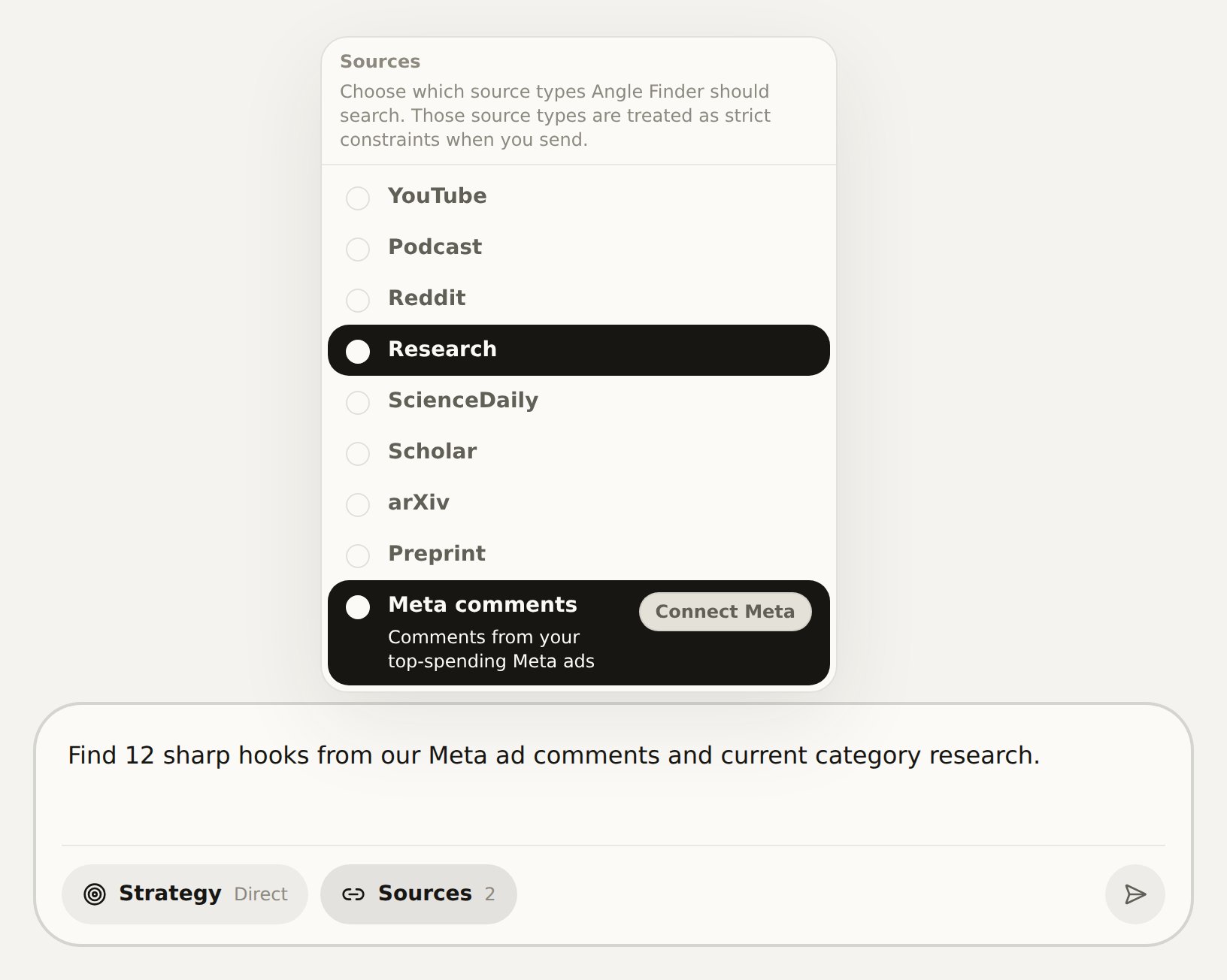
When Meta comments needs access, the source menu shows the Meta connection action before the request is sent.
The Translocate ideas feel random
The Translocate ideas feel random
The research is useful but not ready for ads
The research is useful but not ready for ads