

What this article shows you
Products, Projects and Chats solve different context problems:- A Product holds stable brand and offer context.
- A Project keeps related work, files and short shared instructions together.
- A Chat handles one focused execution and its follow-ups.
Practical use cases
Reuse one workflow
Keep a repeatable ad or advertorial process in one Project, then start one
Chat for each execution.
Switch offers cleanly
Keep each offer in its own Product and mention the relevant Product in the
Chat that needs it.
Run a focused campaign
Create a dedicated Project when a launch needs its own brief, files and
decision history.
Keep one-off work light
Use a regular Chat for a short task that does not need a lasting workspace.
Hand work to your team
Make the Project, required Products and required Chats available to the
team as separate visibility decisions.
Keep decisions with the work
Keep one execution and its follow-up decisions in the same Chat so the
next person can see what changed and why.
Use this mental model
The layers work together, but they are not interchangeable. A Project can link Products. A Chat can belong to one Project or remain outside Projects.
How context reaches a Chat
Start the Chat inside a Project
Start the Chat inside a Project when it should stay organized with that work. The Project’s instructions, linked Products and relevant files are available as context.Mention a Product or Project in a regular Chat
Type@ and choose a Product or Project when a regular Chat needs that context.
Mentioning a Project does not move the Chat into that Project. The Chat keeps its existing Project association, if any.
Attach evidence to one Chat
Use a Chat attachment for evidence that belongs to one conversation. Say how StefanBrain should use it and which decision it supports.A practical pattern
Create one Native-style advertorial system Project. Keep its instructions short, and add only reusable examples or checklists. Start one Chat for each deliverable. Mention the Product for that offer in the Chat, then describe the result you need.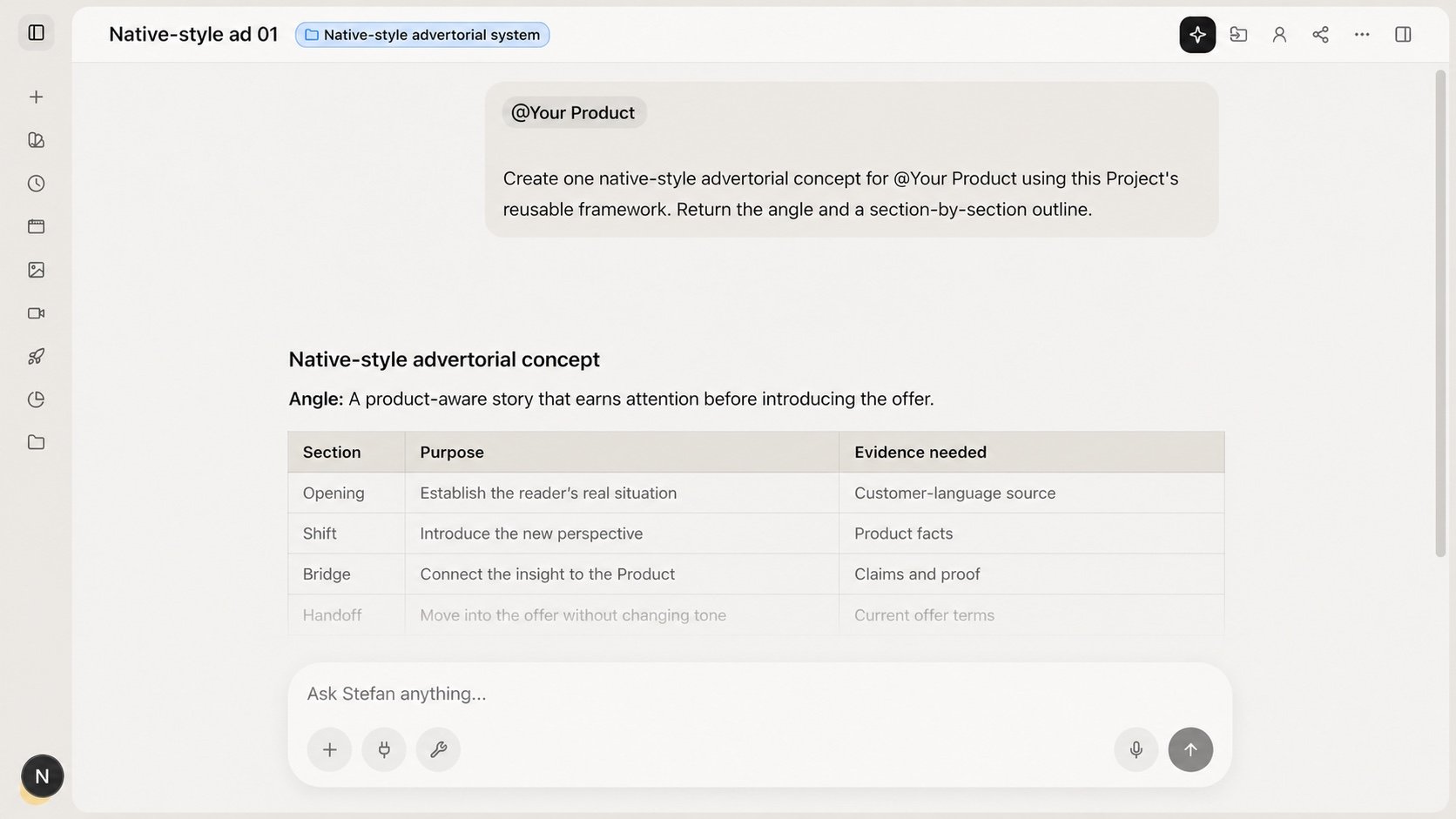
A focused Project Chat adds the Product needed for this execution instead of loading every offer into the Project.
Share a Project with your team
1
Open the Project
Find the person-shaped visibility control in the Project header. It shows
Personal or Team.
2
Change it to Team
Select Personal and confirm the control settles on Team.
3
Share the other required resources
Change each required Product and Chat to Team separately. Project
visibility does not cascade to them.
4
Return it to Personal when needed
Select Team to return the Project to Personal visibility.
Common mistakes
- Putting stable brand facts in Project instructions. Keep them in the Product.
- Creating a Project for every execution. Reuse the Project and start a focused Chat.
- Loading every available file. Add only sources relevant to the current workflow.
- Assuming
@Projectmoves a Chat. Start inside the Project when you want the Chat stored there. - Assuming Team visibility shares everything. Share each required resource separately.