> ## Documentation Index
> Fetch the complete documentation index at: https://docs.stefanbrain.com/llms.txt
> Use this file to discover all available pages before exploring further.
> ## Agent Instructions
> Follow the content contract in AGENTS.md.
> Treat text as the canonical explanation; video and screenshots enhance it.
> Do not publish unverified product behavior or duplicate an existing canonical article.
# Find campaign angles with Angle Finder
> Use customer language, scientific research, cross-category ideas, and reviews to find campaign angles you can develop.
## What this article shows you
Angle Finder turns source material into campaign angles, hooks, and mechanisms
you can evaluate. It combines research with StefanBrain's creative intelligence
instead of returning a list of links alone.
**Normally, do not manually select a tool, including Angle Finder.** Tell
StefanBrain the job, context, source, and result you want. This gives it room
to choose or combine the best capabilities. Select Angle Finder yourself only
when you need its specific strategy, sources, or result format.
## Practical use cases
Find source-linked hooks and angles in the words, emotions, and objections
your market uses naturally.
Find differentiated mechanisms, useful supporting research, and fresh ways
to explain the problem.
Find cross-category concepts and build a clear bridge back to your product.
Turn objections, customer sentiment, and repeated phrases into campaign
angles.
Start with **Reddit customer voice** when you are unsure which path to use.
It can surface specific language you can turn into hooks quickly.
## Watch the walkthrough
Use the **CC** control in the Loom player to show English captions. You can also
[open the walkthrough in Loom](https://www.loom.com/share/868fe81f0734487e80d00a52a124f194).
### Video chapters
| Time | Chapter |
| - | - |
| **00:00** | Angle Finder overview |
| **02:08** | Find emotional, authority-based angles in customer language |
| **04:30** | Use scientific sources to find hooks and mechanisms |
| **06:42** | Borrow angles from other niches with Translocate |
| **09:48** | Mine competitors, reviews, and objections |
| **14:43** | Turn a selected angle into ads and images |
## How Angle Finder fits into Chat
Angle Finder is one way StefanBrain can complete a research job. Start by
describing the outcome naturally. You can ask StefanBrain to use Angle Finder
without selecting it from **Tools**.
This flexible path lets StefanBrain use Angle Finder, deep research, or another
useful combination. Review research, for example, may use deep research instead
of forcing Angle Finder.
## What you will do
1. Choose one research use case.
2. Describe the result, relevant context, and evidence to use.
3. Inspect the source context behind the results.
4. Select one angle with a credible product bridge.
5. Develop that angle into the next campaign asset.
## Before you start
Prepare:
* One product or offer.
* One market, audience, or niche.
* One research goal, such as cold-traffic ad angles or mechanisms.
* The next deliverable you want after the research.
Use a Product mention such as `@Your Product` when you want StefanBrain to use
that Product's saved context.
## Give StefanBrain the complete job
A useful request starts with the outcome, then adds the context and evidence
that materially change the job. Ask directly for the deliverable your team will
use. Name a research strategy or source only when you need that exact path.
For example, this request gives StefanBrain a clear business outcome without
turning the prompt into a form:
```text theme={"system"}
Find 10 cold-traffic angles for @Your Product and [target audience].
Use [source, strategy, or evidence] to uncover tensions competitors may be
missing. Return a ranked shortlist for the creative team, with the source,
customer language, product bridge, and a possible hook for each angle.
```
The playbook prompts below work as standalone requests. A follow-up in the same
Chat can reuse established context, but it should still name the selected
result and the next deliverable.
## Use case #1: Find customer language on Reddit
Use Reddit when you need emotional language, objections, failed solutions, or
beliefs expressed in the customer's own words.
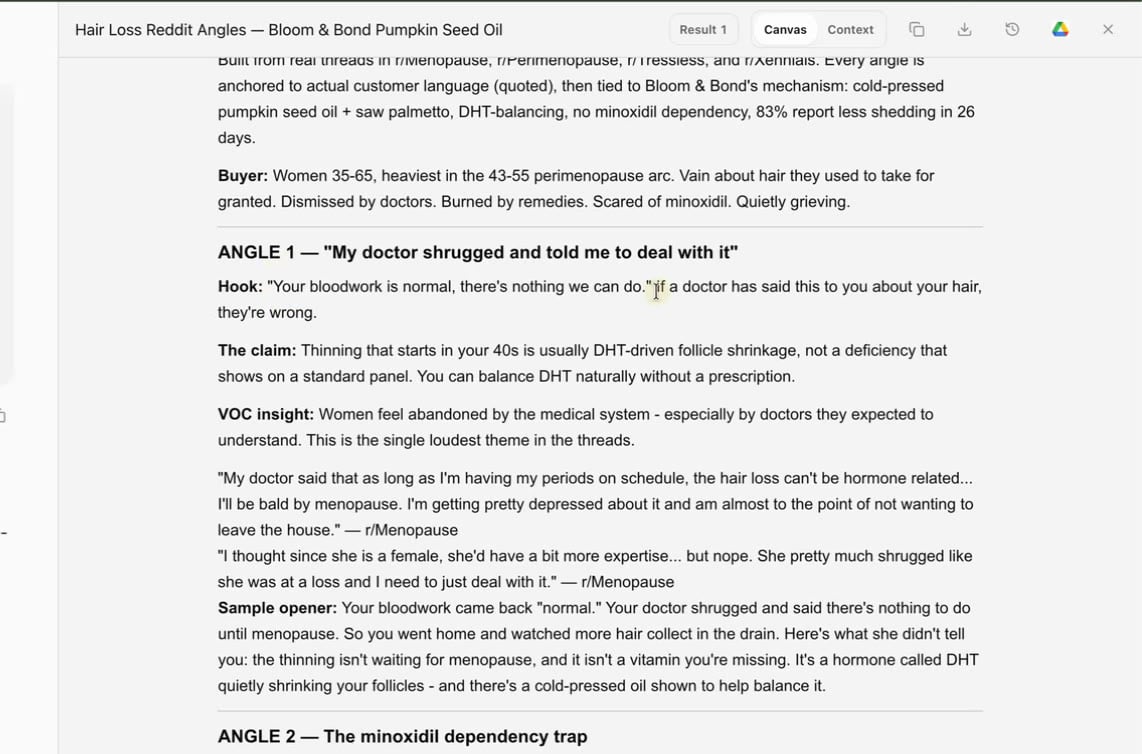
In the hair-loss example, one Reddit quote describes a doctor dismissing
hormone-related hair loss. That tension can support an authority-based angle
about feeling abandoned by the medical system.
The same research identifies fear around starting and stopping minoxidil,
which can support a different angle around dependency.
 Use this request to turn recurring customer language into source-linked angles
your creative team can evaluate:
```text theme={"system"}
Run Angle Finder across [your niche].
Focus specifically on Reddit.
The goal is to find at least 10 cold-traffic ad angles
for @Your Product using the real voice of [target audience].
Research discussions from potential customers.
Look for frustrations, objections, failed alternatives,
desired outcomes, and repeated beliefs.
For each angle, include the exact quote and source link.
Identify the underlying tension and state the angle.
Explain the credible bridge to @Your Product.
Include the original language and source link beside each angle.
```
**Pro tip:** If your brand has little Reddit discussion, research the wider
niche. You can also name competitors or public figures whose audiences discuss
the same problem. This gives StefanBrain a larger pool of real customer
language without limiting the research to mentions of your brand.
### What to inspect
* The exact customer quote and its context.
* Whether the emotion appears across several discussions or only once.
* The bridge from the quote to your product.
* Whether the angle can lead naturally to the campaign you want to create.
### Useful next request
Use this follow-up to group repeated tensions and decide which five angles
deserve the first creative review:
```text theme={"system"}
Group these angles by recurring emotion and objection.
Rank the five best for cold traffic.
Keep the customer language and source attached to each one.
```
## Use case #2: Find science-based mechanisms
Use scientific sources when you need possible mechanisms, emerging
explanations, or research-backed starting points.
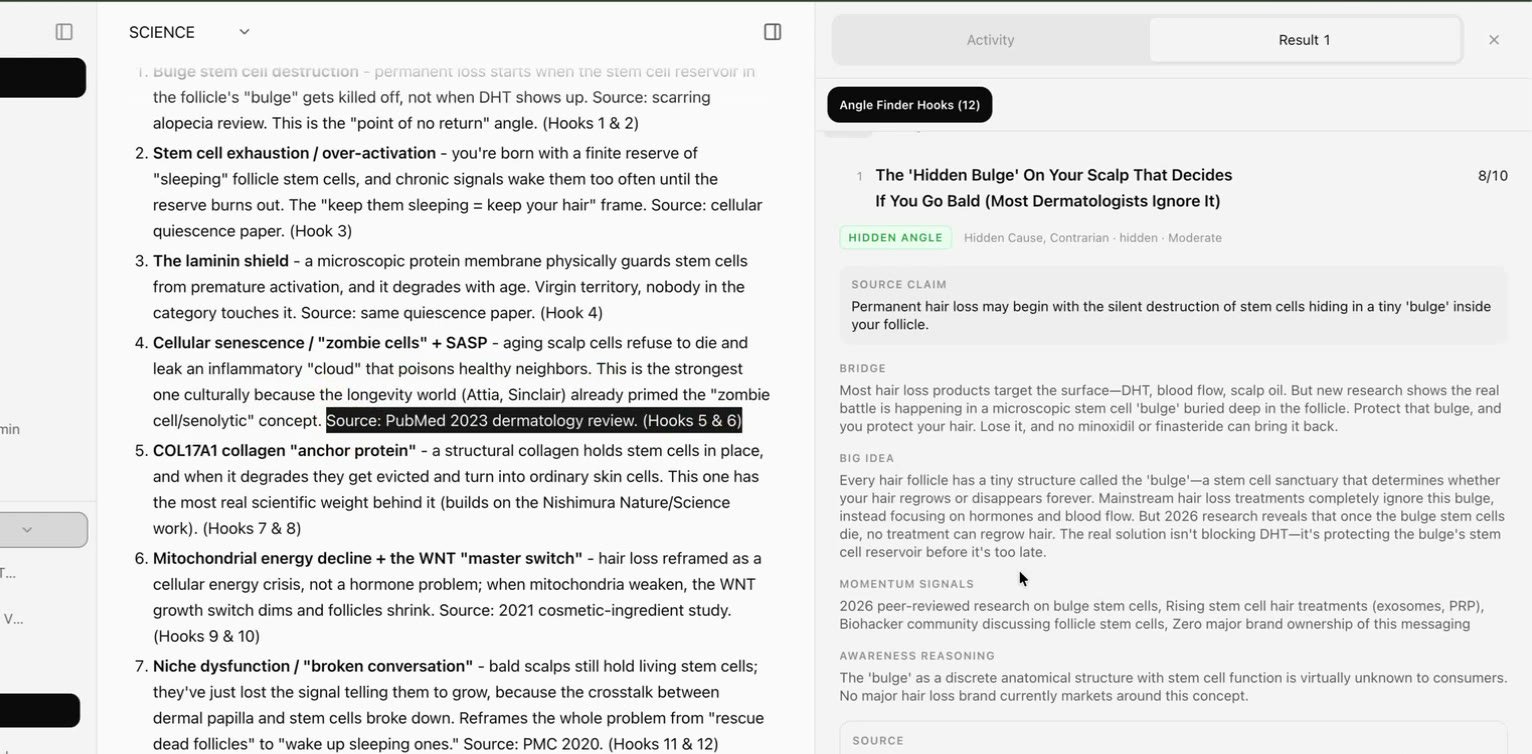
Research in the hair-loss category can surface mechanisms such as cellular
senescence, described as “zombie cells,” and an anchor-protein mechanism
connected to follicle stem cells.
Use this request to turn recurring customer language into source-linked angles
your creative team can evaluate:
```text theme={"system"}
Run Angle Finder across [your niche].
Focus specifically on Reddit.
The goal is to find at least 10 cold-traffic ad angles
for @Your Product using the real voice of [target audience].
Research discussions from potential customers.
Look for frustrations, objections, failed alternatives,
desired outcomes, and repeated beliefs.
For each angle, include the exact quote and source link.
Identify the underlying tension and state the angle.
Explain the credible bridge to @Your Product.
Include the original language and source link beside each angle.
```
**Pro tip:** If your brand has little Reddit discussion, research the wider
niche. You can also name competitors or public figures whose audiences discuss
the same problem. This gives StefanBrain a larger pool of real customer
language without limiting the research to mentions of your brand.
### What to inspect
* The exact customer quote and its context.
* Whether the emotion appears across several discussions or only once.
* The bridge from the quote to your product.
* Whether the angle can lead naturally to the campaign you want to create.
### Useful next request
Use this follow-up to group repeated tensions and decide which five angles
deserve the first creative review:
```text theme={"system"}
Group these angles by recurring emotion and objection.
Rank the five best for cold traffic.
Keep the customer language and source attached to each one.
```
## Use case #2: Find science-based mechanisms
Use scientific sources when you need possible mechanisms, emerging
explanations, or research-backed starting points.
Research in the hair-loss category can surface mechanisms such as cellular
senescence, described as “zombie cells,” and an anchor-protein mechanism
connected to follicle stem cells.
 Use this request to compare possible mechanisms and choose which product bridge
deserves deeper review:
```text theme={"system"}
Run Angle Finder across [your niche].
Focus specifically on credible scientific sources.
The goal is to find at least five unique mechanisms
we could test as big ideas in cold-traffic ads
for @Your Product and [target audience].
Research relevant journals, Scholar, ScienceDaily,
arXiv, and preprints.
For each mechanism, return the source,
what the source says, a plain-language explanation,
a possible hook, and the connection to @Your Product.
Include the source link beside each mechanism.
```
### What to inspect
* Whether the source is a primary study, review, preprint, or summary.
* Whether the research studied the right audience, condition, and outcome.
* Which words come from the source and which are StefanBrain's interpretation.
* Whether the product can credibly connect to the mechanism.
### Useful next request
Use this follow-up to compare the mechanisms and choose which one warrants
deeper product-fit and source review:
```text theme={"system"}
Compare mechanisms four, five, and seven.
Rank them by novelty, product fit, and cold-traffic potential.
```
## Use case #3: Borrow ideas from other niches
Use Translocate when your category repeats the same hooks and you want less
obvious starting points. It searches adjacent or distant domains, then explains
the bridge back to your product.
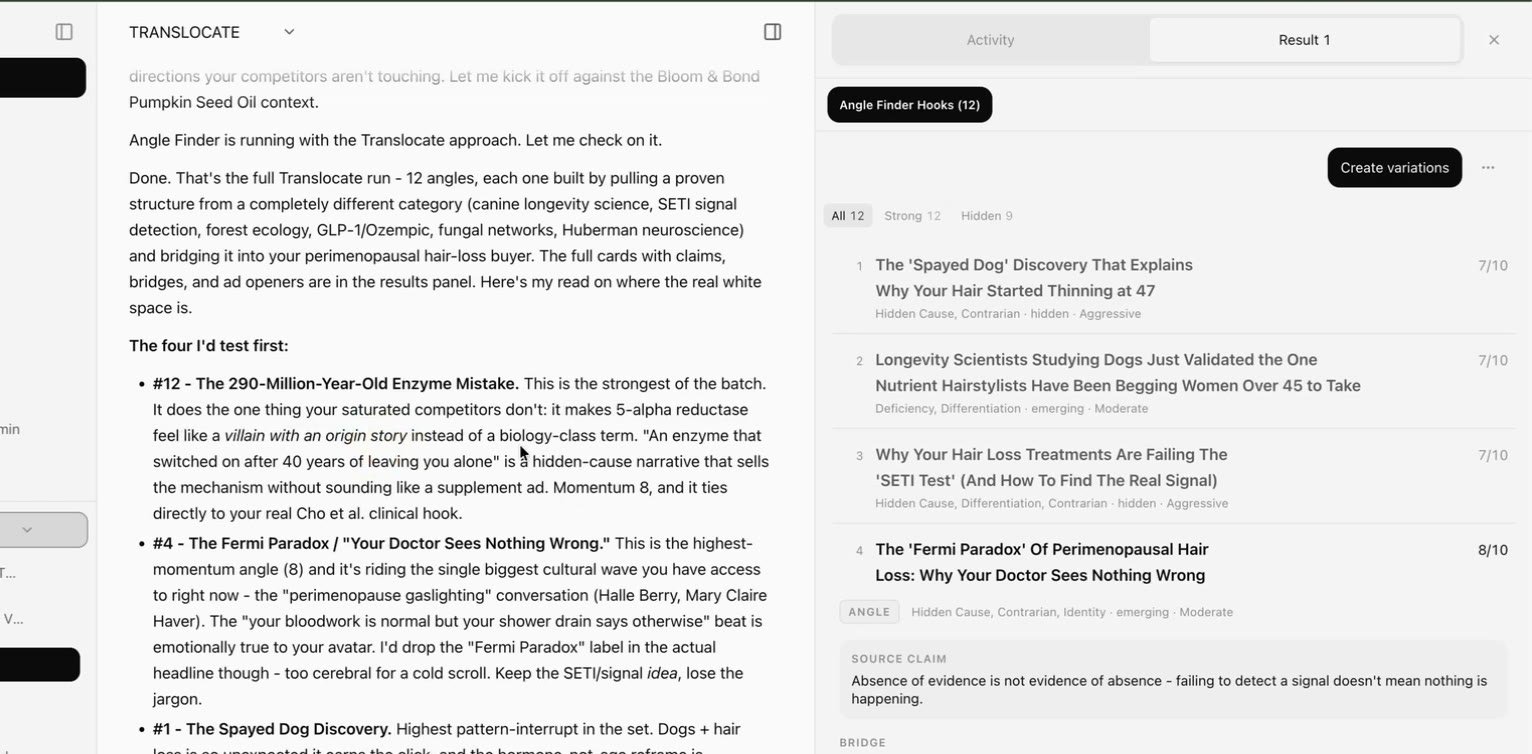
A cross-category result can link a 400-million-year-old plant-defense story to
phytosterols in pumpkin seeds, creating a less familiar concept to evaluate for
further development.
Use this request to compare possible mechanisms and choose which product bridge
deserves deeper review:
```text theme={"system"}
Run Angle Finder across [your niche].
Focus specifically on credible scientific sources.
The goal is to find at least five unique mechanisms
we could test as big ideas in cold-traffic ads
for @Your Product and [target audience].
Research relevant journals, Scholar, ScienceDaily,
arXiv, and preprints.
For each mechanism, return the source,
what the source says, a plain-language explanation,
a possible hook, and the connection to @Your Product.
Include the source link beside each mechanism.
```
### What to inspect
* Whether the source is a primary study, review, preprint, or summary.
* Whether the research studied the right audience, condition, and outcome.
* Which words come from the source and which are StefanBrain's interpretation.
* Whether the product can credibly connect to the mechanism.
### Useful next request
Use this follow-up to compare the mechanisms and choose which one warrants
deeper product-fit and source review:
```text theme={"system"}
Compare mechanisms four, five, and seven.
Rank them by novelty, product fit, and cold-traffic potential.
```
## Use case #3: Borrow ideas from other niches
Use Translocate when your category repeats the same hooks and you want less
obvious starting points. It searches adjacent or distant domains, then explains
the bridge back to your product.
A cross-category result can link a 400-million-year-old plant-defense story to
phytosterols in pumpkin seeds, creating a less familiar concept to evaluate for
further development.
 Use this request to find cross-category ideas and return the product bridge your
team needs to judge whether each one is useful:
```text theme={"system"}
Use Angle Finder and the Translocate strategy
for @Your Product in [your niche].
The goal is to find at least 10 differentiated
cold-traffic ad angles for [target audience]
that competitors are unlikely to be using.
Research mechanisms, analogies, and proven ideas
from adjacent and distant industries.
For each angle, return the outside-domain source,
the original idea, the bridge back to @Your Product,
and a possible hook.
```
### What to inspect
* Whether the borrowed idea has a clear bridge to the product.
* Whether the angle still matters to the target customer.
* Whether the idea is useful, not merely unusual.
### Useful next request
Use this follow-up to narrow the results to the three ideas with the clearest
product bridge:
```text theme={"system"}
Show me the three Translocate angles
with the clearest product bridge.
Explain the bridge from each source to the Product.
```
## Use case #4: Mine competitors and reviews
Use reviews, comments, and competitor discussions to find buying objections,
feared trade-offs, positive sentiment, and phrases customers repeat.
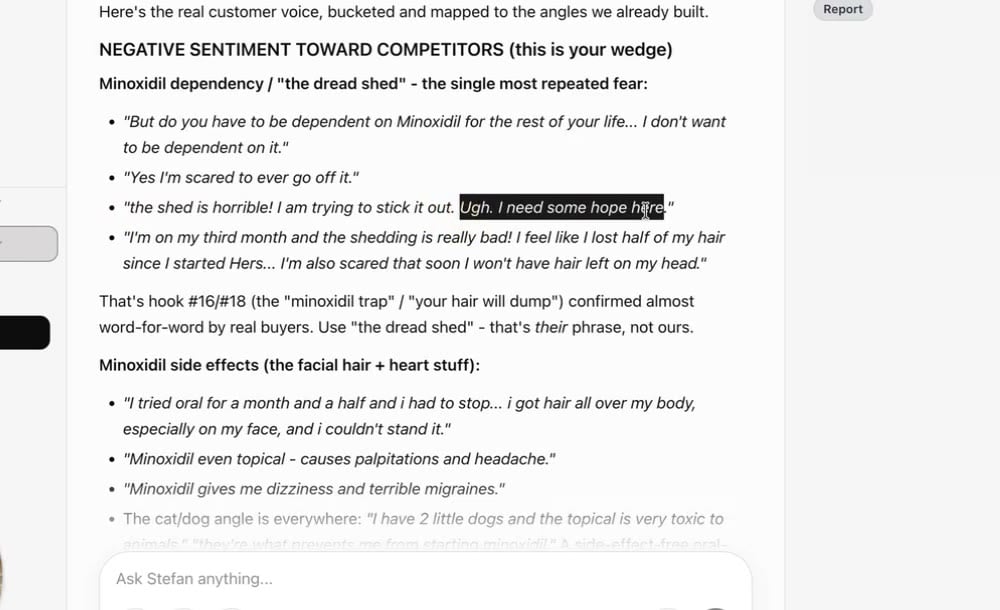
Research across hair-loss products and competitors can surface repeated fears
about minoxidil dependency and shedding, plus frustration with doctors and slow
results.
Use this request to find cross-category ideas and return the product bridge your
team needs to judge whether each one is useful:
```text theme={"system"}
Use Angle Finder and the Translocate strategy
for @Your Product in [your niche].
The goal is to find at least 10 differentiated
cold-traffic ad angles for [target audience]
that competitors are unlikely to be using.
Research mechanisms, analogies, and proven ideas
from adjacent and distant industries.
For each angle, return the outside-domain source,
the original idea, the bridge back to @Your Product,
and a possible hook.
```
### What to inspect
* Whether the borrowed idea has a clear bridge to the product.
* Whether the angle still matters to the target customer.
* Whether the idea is useful, not merely unusual.
### Useful next request
Use this follow-up to narrow the results to the three ideas with the clearest
product bridge:
```text theme={"system"}
Show me the three Translocate angles
with the clearest product bridge.
Explain the bridge from each source to the Product.
```
## Use case #4: Mine competitors and reviews
Use reviews, comments, and competitor discussions to find buying objections,
feared trade-offs, positive sentiment, and phrases customers repeat.
Research across hair-loss products and competitors can surface repeated fears
about minoxidil dependency and shedding, plus frustration with doctors and slow
results.
 If your team has a customer-review source connected in StefanBrain, name it
in the request so StefanBrain can use the available review data. Otherwise,
attach a review export or include the public review URLs you want researched. Browse
[connectors and schedules](/knowledge-base/connectors-automations).
Use this request to turn repeated objections and customer language into a
ranked set of angles for cold-traffic creative:
```text theme={"system"}
Research customer reviews for competitors
and other products in [your niche].
The goal is to find at least 20 cold-traffic ad angles
for @Your Product using the real voice of [target audience].
Use [connected review source or public review URLs].
Look for objections, positive and negative sentiment,
desired outcomes, repeated phrases, and failed solutions.
For each angle, return the source, customer language,
sentiment or objection, proposed hook,
and connection to @Your Product.
Include the original customer language and source beside each angle.
```
StefanBrain may use deep research instead of Angle Finder for part of this job.
Judge the evidence and result, not whether one named tool handled every step.
## Turn one angle into campaign assets
Choose an angle before asking for finished creative. Continue in the same Chat
so the evidence and selection reason stay connected.
Refer to the result number and restate its central idea. Explain why you
selected it and which source-backed detail must stay intact.
Request a clear next result, such as two static-ad concepts, a UGC script,
an advertorial outline, or a Google Doc for team review.
State the audience, channel, voice, length, offer, and number of variations
only when those constraints support the campaign.
Confirm that the output uses the selected angle and preserves the relevant
evidence.
Use this follow-up to turn one selected angle into two concepts the creative
team can compare:
```text theme={"system"}
Turn angle eight into two static-ad concepts
for [audience and channel].
Use this exact angle and preserve its source-backed mechanism.
Write in [voice and length] for [campaign purpose].
Explain how each variation expresses the angle differently.
```
If your team has a customer-review source connected in StefanBrain, name it
in the request so StefanBrain can use the available review data. Otherwise,
attach a review export or include the public review URLs you want researched. Browse
[connectors and schedules](/knowledge-base/connectors-automations).
Use this request to turn repeated objections and customer language into a
ranked set of angles for cold-traffic creative:
```text theme={"system"}
Research customer reviews for competitors
and other products in [your niche].
The goal is to find at least 20 cold-traffic ad angles
for @Your Product using the real voice of [target audience].
Use [connected review source or public review URLs].
Look for objections, positive and negative sentiment,
desired outcomes, repeated phrases, and failed solutions.
For each angle, return the source, customer language,
sentiment or objection, proposed hook,
and connection to @Your Product.
Include the original customer language and source beside each angle.
```
StefanBrain may use deep research instead of Angle Finder for part of this job.
Judge the evidence and result, not whether one named tool handled every step.
## Turn one angle into campaign assets
Choose an angle before asking for finished creative. Continue in the same Chat
so the evidence and selection reason stay connected.
Refer to the result number and restate its central idea. Explain why you
selected it and which source-backed detail must stay intact.
Request a clear next result, such as two static-ad concepts, a UGC script,
an advertorial outline, or a Google Doc for team review.
State the audience, channel, voice, length, offer, and number of variations
only when those constraints support the campaign.
Confirm that the output uses the selected angle and preserves the relevant
evidence.
Use this follow-up to turn one selected angle into two concepts the creative
team can compare:
```text theme={"system"}
Turn angle eight into two static-ad concepts
for [audience and channel].
Use this exact angle and preserve its source-backed mechanism.
Write in [voice and length] for [campaign purpose].
Explain how each variation expresses the angle differently.
```
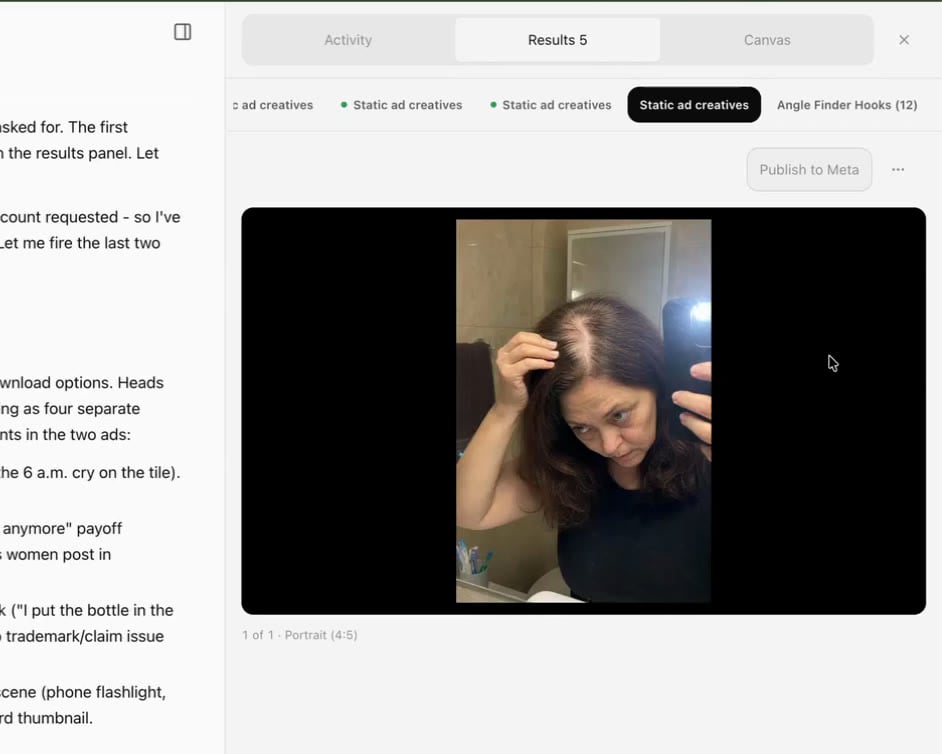 Long-form, story-based copy and an aggressive voice are optional constraints.
Match the format and tone to your brand, audience, and campaign.
## Manually select Angle Finder for rigid control
Use this path only when you need one strategy, constrained source types, and
Angle Finder's source-driven result format.
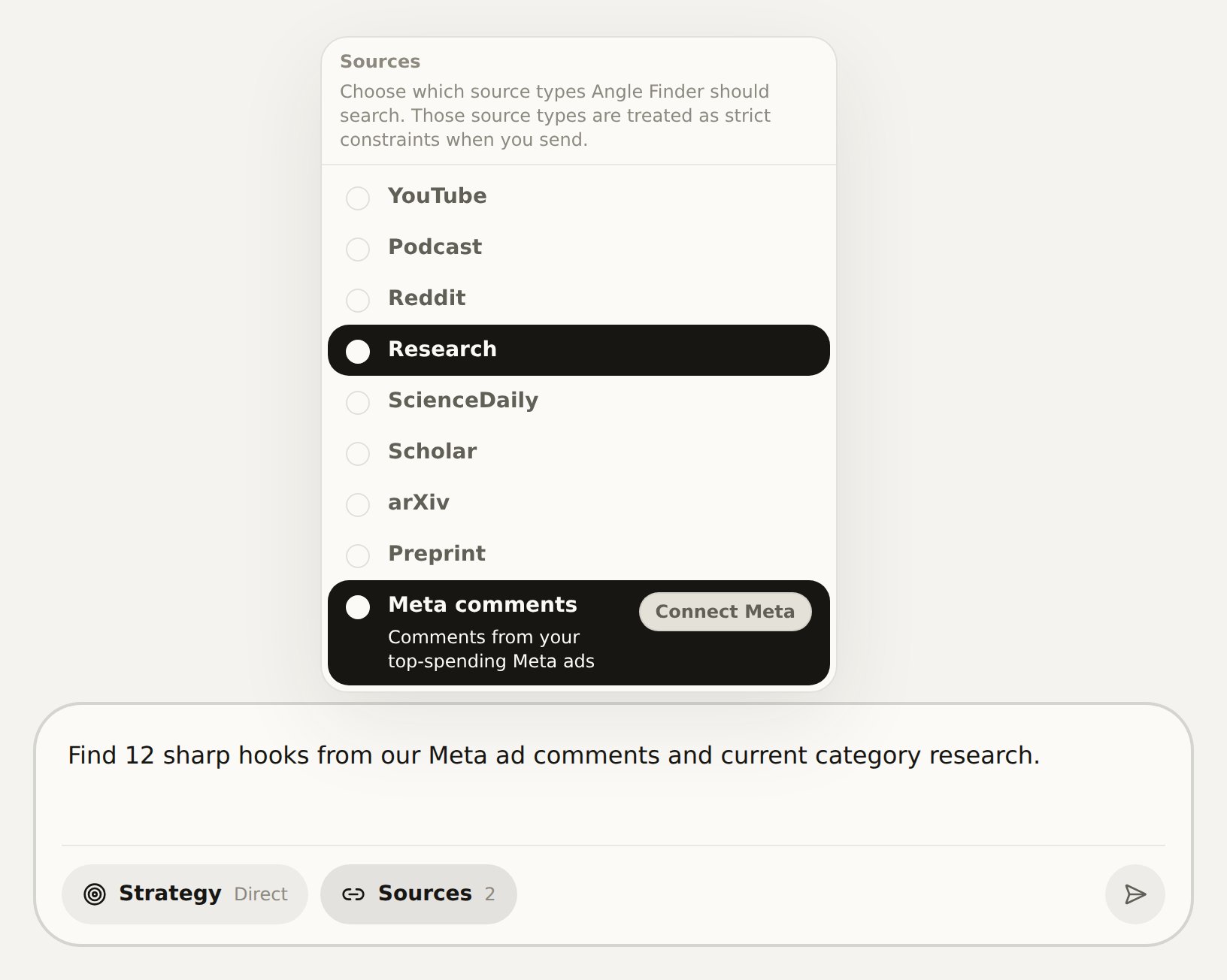
In Chat, select **Tools**, then select **Angle Finder**. The composer shows
**Strategy** and **Sources**.
Long-form, story-based copy and an aggressive voice are optional constraints.
Match the format and tone to your brand, audience, and campaign.
## Manually select Angle Finder for rigid control
Use this path only when you need one strategy, constrained source types, and
Angle Finder's source-driven result format.
In Chat, select **Tools**, then select **Angle Finder**. The composer shows
**Strategy** and **Sources**.
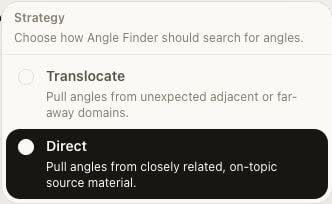
 Use **Direct** for closely related, on-topic sources. Use **Translocate** for
deliberate research across adjacent or distant domains.
Use **Direct** for closely related, on-topic sources. Use **Translocate** for
deliberate research across adjacent or distant domains.
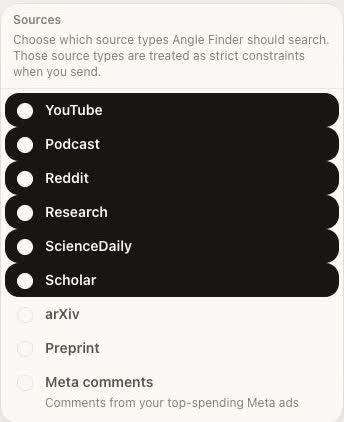
 Select only sources that can answer the question. Current choices are
**YouTube**, **Podcast**, **Reddit**, **Research**, **ScienceDaily**,
**Scholar**, **arXiv**, **Preprint**, and **Meta comments**.
Select only sources that can answer the question. Current choices are
**YouTube**, **Podcast**, **Reddit**, **Research**, **ScienceDaily**,
**Scholar**, **arXiv**, **Preprint**, and **Meta comments**.
 State the product, market, research goal, and deliverable. Review the
returned source context before developing an angle.
## Check the output
* Identify the audience tension behind the angle.
* Confirm which quote, observation, or source supports it.
* Check that the bridge to the product is clear.
* Separate what is sourced from what is inferred.
* Choose one concrete hypothesis or deliverable to test next.
Treat the first set as options. Choose one useful direction, then develop it
into the next campaign asset.
## Best practices
* Lead with the result. Add Product or audience context, an evidence source,
and a format only when they materially change the job.
* Be specific about the source, intent, and output you want.
* Start with Reddit when direct customer language is the main unknown.
* Use science to find mechanisms and clearer ways to explain the problem.
* Use Translocate for deliberate cross-category exploration, not novelty alone.
* Preserve direct quotes, links, and source context.
* Select a direction before generating more assets.
## Common mistakes
* **Selecting Angle Finder for every research request.** This can reduce
StefanBrain's flexibility to combine useful capabilities.
* **Asking for “good angles” without an evidence goal.** Name the source,
market, and intended deliverable.
* **Choosing a mechanism with no Product bridge.** Favor ideas that connect
naturally to the offer and matter to the customer.
* **Choosing novelty without a product bridge.** A distant idea still needs to
matter to the customer and product.
* **Generating more before deciding.** Compare the first useful set and choose
a direction to develop.
## Troubleshooting
Narrow the request. Name one audience, one source strategy, the campaign
use, and the evidence each result should preserve.
Choose another relevant source, broaden the niche, or name a competitor or
public figure whose audience discusses the same problem.
Confirm that the intended Meta account has ads with usable comments. If
StefanBrain shows a reconnect state, open **Connectors** and reconnect Meta.
If the account appears connected but still returns no comments, confirm the
selected ad account. Reconnecting Meta can restore comment access when the
connection has expired.
State the product, market, research goal, and deliverable. Review the
returned source context before developing an angle.
## Check the output
* Identify the audience tension behind the angle.
* Confirm which quote, observation, or source supports it.
* Check that the bridge to the product is clear.
* Separate what is sourced from what is inferred.
* Choose one concrete hypothesis or deliverable to test next.
Treat the first set as options. Choose one useful direction, then develop it
into the next campaign asset.
## Best practices
* Lead with the result. Add Product or audience context, an evidence source,
and a format only when they materially change the job.
* Be specific about the source, intent, and output you want.
* Start with Reddit when direct customer language is the main unknown.
* Use science to find mechanisms and clearer ways to explain the problem.
* Use Translocate for deliberate cross-category exploration, not novelty alone.
* Preserve direct quotes, links, and source context.
* Select a direction before generating more assets.
## Common mistakes
* **Selecting Angle Finder for every research request.** This can reduce
StefanBrain's flexibility to combine useful capabilities.
* **Asking for “good angles” without an evidence goal.** Name the source,
market, and intended deliverable.
* **Choosing a mechanism with no Product bridge.** Favor ideas that connect
naturally to the offer and matter to the customer.
* **Choosing novelty without a product bridge.** A distant idea still needs to
matter to the customer and product.
* **Generating more before deciding.** Compare the first useful set and choose
a direction to develop.
## Troubleshooting
Narrow the request. Name one audience, one source strategy, the campaign
use, and the evidence each result should preserve.
Choose another relevant source, broaden the niche, or name a competitor or
public figure whose audience discusses the same problem.
Confirm that the intended Meta account has ads with usable comments. If
StefanBrain shows a reconnect state, open **Connectors** and reconnect Meta.
If the account appears connected but still returns no comments, confirm the
selected ad account. Reconnecting Meta can restore comment access when the
connection has expired.
 Ask StefanBrain to explain the bridge to the product. Discard ideas whose
bridge is unclear or irrelevant to the customer.
Ask StefanBrain to separate evidence from interpretation. Select one angle,
then request one controlled deliverable.
## Related articles
* [Creative Strategist and research](/knowledge-base/creative-strategist-research)
* [Products, Projects, and Chats](/knowledge-base/get-started/products-projects-and-chats)
* [Connectors and schedules](/knowledge-base/connectors-automations)
This documentation is built and hosted on [Mintlify](https://mintlify.com), a developer documentation platform.
Ask StefanBrain to explain the bridge to the product. Discard ideas whose
bridge is unclear or irrelevant to the customer.
Ask StefanBrain to separate evidence from interpretation. Select one angle,
then request one controlled deliverable.
## Related articles
* [Creative Strategist and research](/knowledge-base/creative-strategist-research)
* [Products, Projects, and Chats](/knowledge-base/get-started/products-projects-and-chats)
* [Connectors and schedules](/knowledge-base/connectors-automations)
This documentation is built and hosted on [Mintlify](https://mintlify.com), a developer documentation platform.